Letters, Layers, and Loud Colour on Canvas
What happens when you spend a week reading about Matisse and then walk into the studio with wet paint still on yesterdays palette?
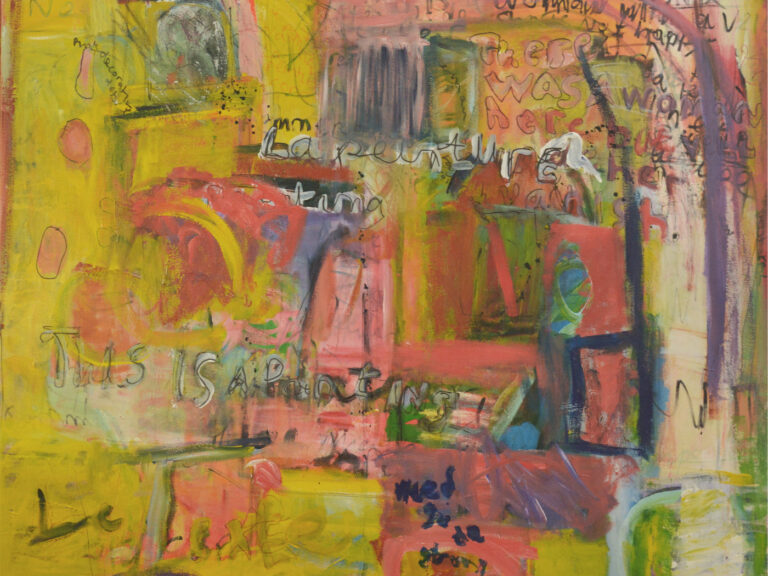
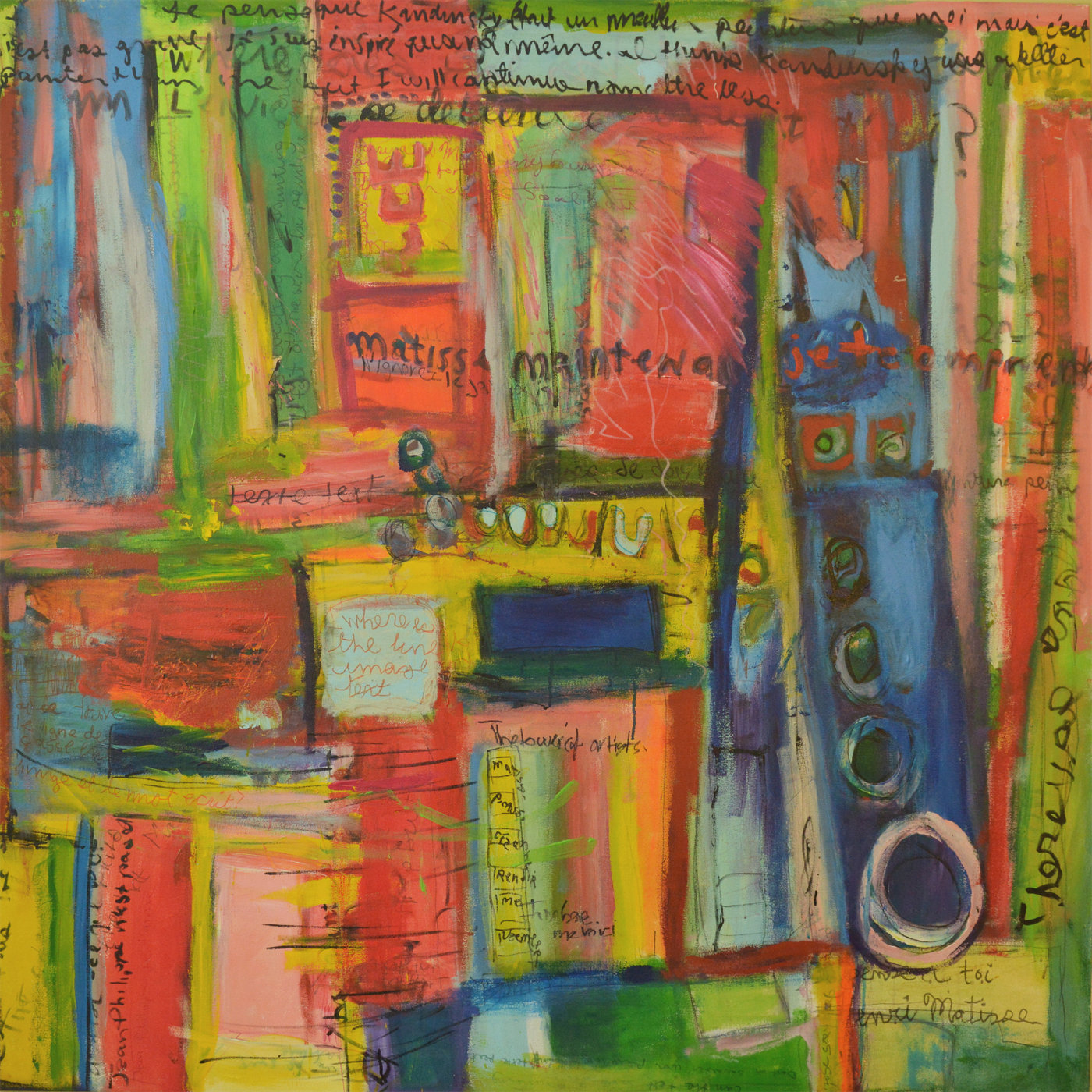
This piece started as a conversation. Not with anyone in the room — with the dead. I’d been reading Matisse’s letters, the ones where he talks about colour like a carpenter talks about wood, and I started writing fragments directly onto the canvas before a single block of paint went down. French phrases, English half-thoughts, names of artists I kept circling back to. Kandinsky shows up in there. So does Renoir. The thing is, I wasn’t planning a painting about Matisse. I was planning a painting that Matisse might have argued with.
And honestly, the title came last.
The First Mark
The first marks weren’t paint at all — they were graphite and oil pastel, scribbled text running edge to edge across raw cotton canvas. I wrote with my left hand for some of it, just to keep the letters loose, almost-illegible-but-not. “Je pense que Kandinsky était un maillon” runs across the top. I can barely read my own handwriting in places, which is the point.
But once that text layer dried, I hit it with a wide flat brush loaded with a too-thin wash of cadmium yellow. The words bled through. Some disappeared. That first yellow wash — maybe 7:30 in the morning, coffee still hot — set the temperature for everything that followed.
Layering & Texture
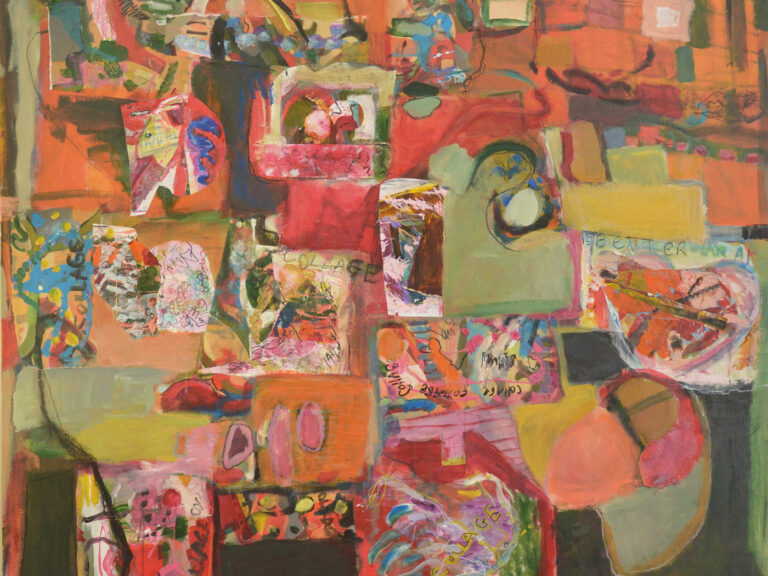
Building this piece meant working wet-over-dry, dry-over-wet, and sometimes wet-into-wet all in the same afternoon. The rectangular colour blocks — those heavy reds, the tall blue column on the right — went down with a 3-inch hardware store brush, the kind with stiff bristles that leave drag marks in the acrylic. I like that grit. It’s not decorative, it’s structural.
Underneath the green and orange sections in the lower left, there are at least four layers you’ll never fully see. A salmon pink. A raw umber I scraped back with a palette knife. Some of the text layers got buried entirely, but their ridges still push through the surface like veins under skin. The circular forms — those stacked ring-shapes along the right side — I built those up with a filbert brush and then carved back into them with the wooden end while the paint was still half-set-but-grabby.
And the scratched lines running through the mid-section? A fork. A literal kitchen fork.
balancing all that chaotic text and colour in the upper half. Sometimes the best decisions are the ones your hand makes before your brain catches up.
Living With It
I finished the painting on a Thursday and didn’t look at it until Monday. Left it on the studio wall, faced outward, and went about my weekend. When I came back, the first thing I noticed was how the blue column reads differently in morning light versus the fluorescent overheads I paint under. Under studio lights, it sits flat. In natural light, it advances — almost steps forward off the surface. The greens do something similar, shifting from acidic to warm depending on the hour.
This is a piece that changes rooms. Loud wall, quiet wall, it doesn’t matter — it reorganizes the space around it, which is exactly what I wanted from the contemporary abstract painting process I was working through here.
[Link to product page: https://adriart.ca/shop/matisse-understood]
Context
Matisse Understood sits in my Canvas series alongside other large-format acrylic on canvas works, but it’s the most text-heavy piece in the group. Most of the Canvas works are pure abstraction — colour, form, surface. This one carries language like cargo. The French and English fragments tie it to a specific line of thinking about influence, about what it means to study someone else’s work and then make your own anyway.
It’s a love letter that argues back.
Within the series, it also marks a shift toward denser, more layered compositions. Earlier pieces had more breathing room. This one packs every square inch. If you’re interested in how my abstract acrylic layering technique has developed over time. For more about my painting practice, visit my bio page.