Heat, Weight, and Working Through It
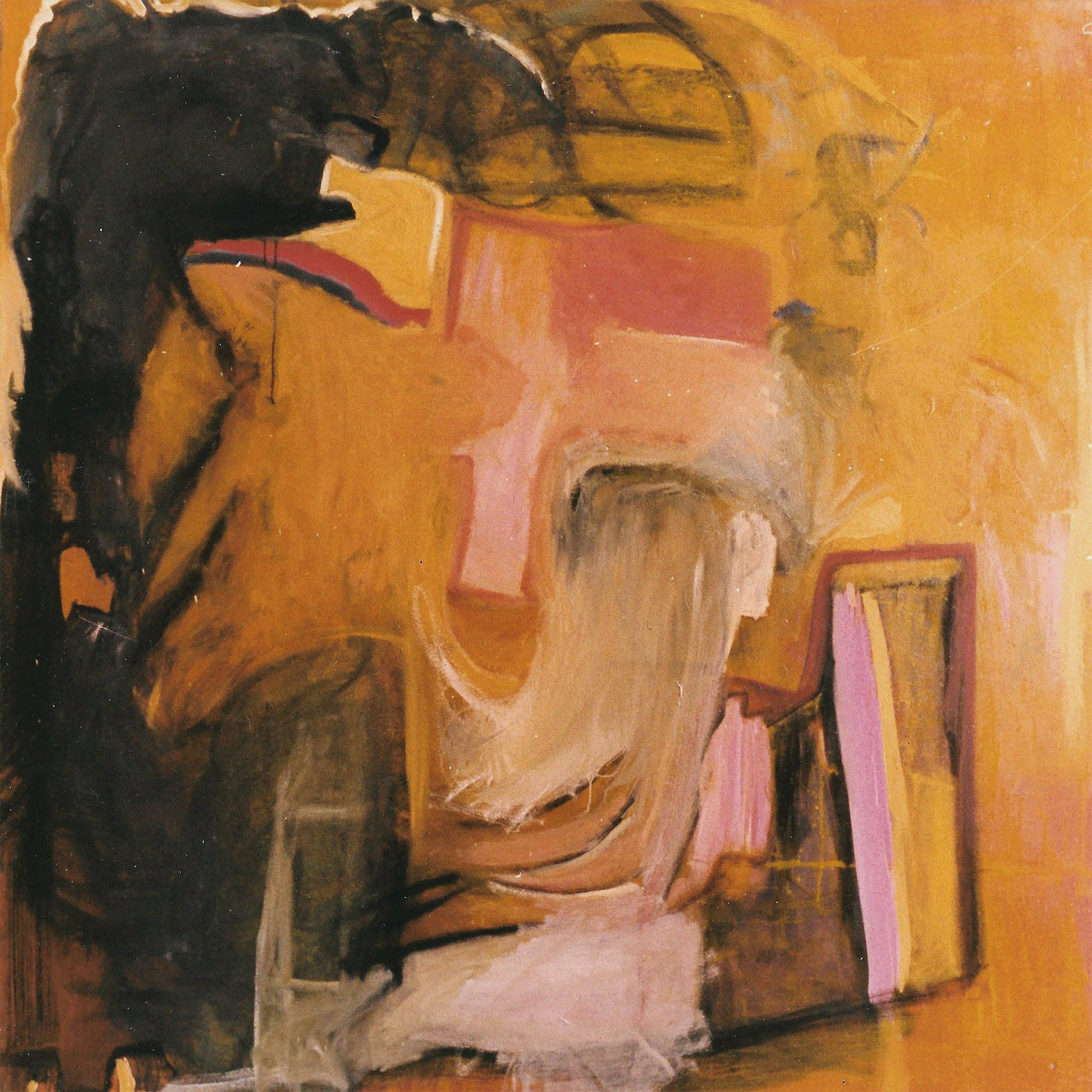
That’s the honest way to describe this painting. Two sides of the canvas arguing. The left half loaded up with something close to black — raw umber piled into burnt sienna until it went almost opaque — and the right half pushing back with this loud, cadmium-adjacent orange that wouldn’t sit still. And somewhere in the middle, a ghostly wash of pale grey and pink trying to mediate.
The Whole Thing Was a Disagreement
Orange Fight isn’t about oranges. It isn’t about fighting, either — not really. It’s about what happens when you commit to two opposing temperatures on the same surface and refuse to let either one win.
Colour as Problem-Solving
The orange was the first problem. I’d mixed a batch using cadmium yellow medium and a spoonful of yellow ochre, then thinned it way down with water so it would stain the canvas instead of sitting on top. But it dried warmer than I expected — almost honey-thick in tone, this too-sweet golden colour that didn’t have enough bite.
So, I dragged raw umber across the left edge. Wet.
That was the second problem, because now the painting was split in half and the dark side was eating everything. I went back in with a pink — not a planned pink, just titanium white muddied with whatever red was already on my palette knife — and cut a rectangle shape into the right side. Kind of like a doorway. And that rectangle is still there in the finished piece, this soft-edged frame-within-a-frame that holds its ground against all that heat.
But the real solving happened when I dragged a wide, flat brush loaded with a barely-tinted white down through the centre. That grey-white cascade broke the stand-off. The painting finally had a third voice.
Layering & Texture
There are at least four layers fighting for the surface here. The first was that thinned orange stain — you can still see it at the top right, where nothing else landed on top and the canvas tooth shows through, almost half-scraped looking. Over that went the dark mass on the left, built up with a 3-inch hardware store brush that leaves these wide, dragging strokes you can see where the umber thins at the edges. The acrylic layering technique on this piece meant working fast, because acrylic on cotton canvas grabs quickly — you get maybe ninety seconds before the tooth locks the pigment down and you can’t push it around anymore.
The pink passages were laid over the orange while it was still tacky. You can see where the two mixed at the border, creating this dusty, skin-like tone that I couldn’t have mixed on a palette.
And then the white. I loaded a flat palette knife with heavy-body titanium white and scraped it downward in one pass. The sound of that — a wet scrape, almost squeaky against the dried acrylic underneath — that’s the moment the contemporary abstract painting process goes from thinking to just reacting.
Edges & Boundaries
What I keep looking at, months later, is where the dark meets the orange. That border isn’t a line. It’s a weather system. The raw umber bleeds into ochre, then there’s a sliver of red — just a thin, accidental-looking ribbon of something close to alizarin — before the orange takes over. It sat there for weeks before I decided not to clean it up.
The rectangle on the right has a different kind of edge. Deliberate. Almost architectural. Pink bordered by a darker mauve outline, like someone drew a door and then thought better of it. But the bottom of that rectangle dissolves into the white cascade, so even the most intentional mark ends up half-surrendered.
The Pause
This painting sat on my studio wall unfinished for close to three weeks. Honestly, I thought it was done twice before it actually was. The first “done” was before the white went in — just orange and dark and pink. It looked complete. It looked like a painting. But every morning when I unlocked the studio and the overhead fluorescents buzzed on, it looked stuck. Too balanced. Too polite for something called Orange Fight.
The white was a last-day decision, and it took maybe forty-five seconds to execute.
Context
Orange Fight belongs to the Canvas series, where I’ve been working at scale on stretched cotton canvas and letting the surface dictate a lot of the pacing. Compared to the smaller works in the series, this one pushed me physically — sixty inches means your whole arm is involved, your shoulder, your weight. The canvas tooth on these larger pieces holds more paint and forgives less.