Stacking Marks on a Five-Foot Canvas
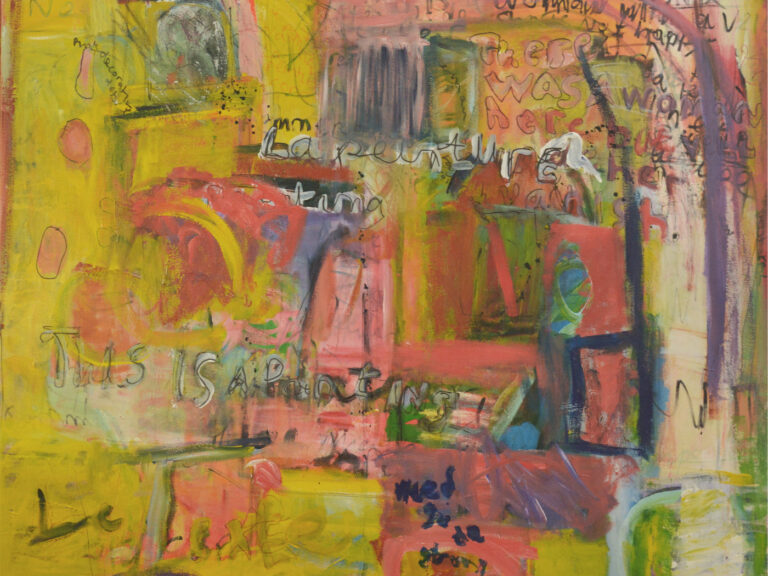
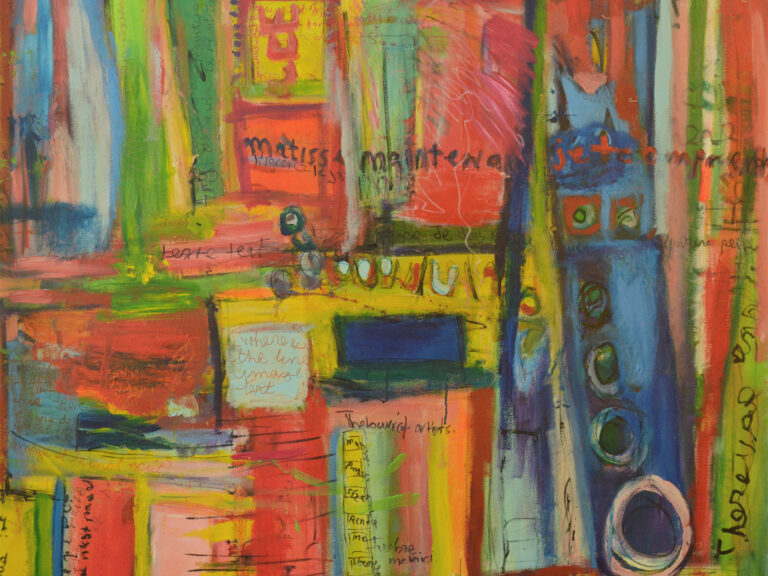
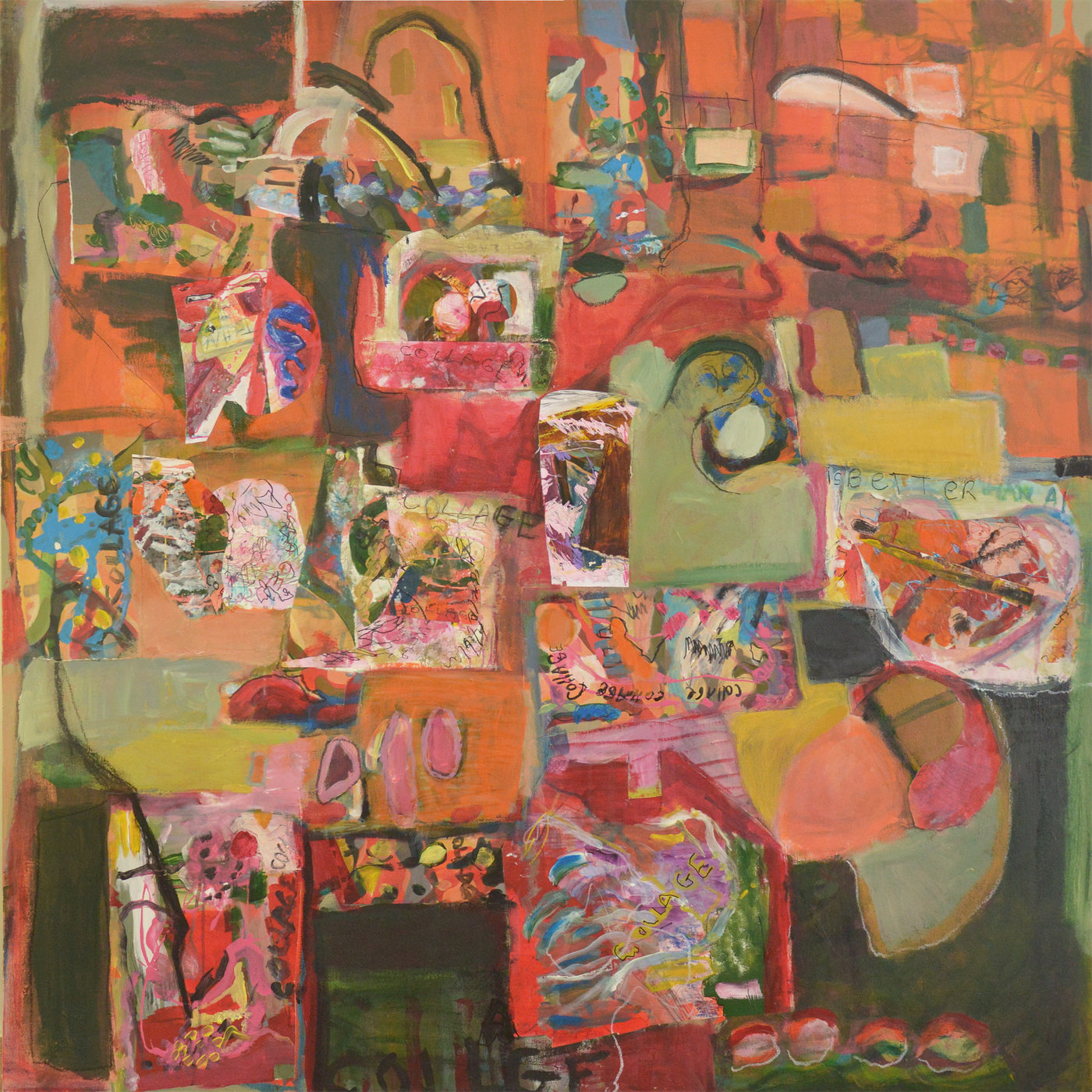
Better Collage, started as a dare to myself. Could I build something that felt like a collage — layered, cluttered, a little chaotic — without actually gluing anything down? Every rectangle, every scrawled word, every half-buried shape is painted, not pasted. And the whole thing lives on a single five-foot-square canvas that I kept feeding for weeks, stacking colour on top of colour until it started to hum.
The title is literal, kind of. “Better Collage” is written right into the surface — you can see it in several spots, scratched in yellow, scribbled in blue. It was a note to myself more than anything, a reminder that the painting should do what collage does — pile things up, let edges show, keep the seams visible — but do it better, or at least differently, using only paint and the tooth of the canvas.
Layering & Texture — Building Up and Scratching Back
The surface on this one is thick in places and nearly bare in others. I built it up with a wide hog-bristle brush first, blocking in those big coral and orange rectangles with a mix of cadmium red light and a cheap orange I keep buying at the dollar store because it has this half-chalky quality that I actually love. Then I’d let a section dry overnight, come back in the morning when the studio was still cold, and drag a palette knife across it — not to remove paint, but to flatten the peaks so the next layer would sit differently.
Sage green and olive went on next, mostly with a worn-out two-inch flat. Those muted greens are what keep the whole thing from tipping into pure heat. I scraped some passages back with the edge of an old gift card until the weave of the canvas started peeking through. That grit underneath — you can feel it if you run your hand along the lower left corner — is what gives those quieter areas their weight. The acrylic layering technique here isn’t precious. It’s closer to packing a suitcase badly: stuff gets shoved in, rearranged, shoved in again.
What Got Removed — Decisions Made by Subtraction
There was a whole face in the centre of this painting. Nose, two eyes, a mouth. I painted over it with that big sage-green rectangle and never looked back. Well — I looked back once, because you can still see a faint blue-yellow curve where the left eye used to be, peeking out from under the green like a ghost of a decision I reversed.
I also killed an entire strip of bright yellow that ran down the right edge. It was too-clean, too stripe-like, too much like a border, and this painting doesn’t want borders. I knocked it back with a washy layer of burnt sienna and then scribbled over it with a China marker. The text that reads “IS BETTER” near the upper right? That’s sitting on top of that graveyard of yellow.
When It Clicks — The Moment the Piece Started Working
For weeks this painting just looked noisy. Not good-noisy. Homework-noisy. I kept adding elements and none of them were talking to each other, they were all just shouting. Then one evening — it was late, I’d been working on something else entirely — I walked past it and saw it from about fifteen feet away, sideways, half in shadow.
Everything locked. The rectangles suddenly read as windows stacked in a crooked building. The scrawled words became graffiti on walls. And the scattered pinks and corals and olives stopped competing and started rhyming.
That’s when I added the last few marks: those small cerulean dots in the lower left and the purple wash near the bottom right. Finishing touches, not fixes. The painting had told me it was almost done, I just needed to listen to it instead of wrestling it.
Context — How This Fits Into the Canvas Series
Better Collage sits inside my Canvas series as one of the more maximal pieces — most of the work in this group is big, but not all of it is this packed. This painting pushes the idea of how much a single abstract acrylic on canvas surface can hold before it starts to collapse. It doesn’t collapse. It holds.
If you’re interested in seeing more from this body of work you can visit the Better Collage product page to see dimensions and pricing. And if you want to know more about how I work, there’s a longer version of that story on my artist bio page.