Rhythm, Black Space, and a Mint-Green Floor
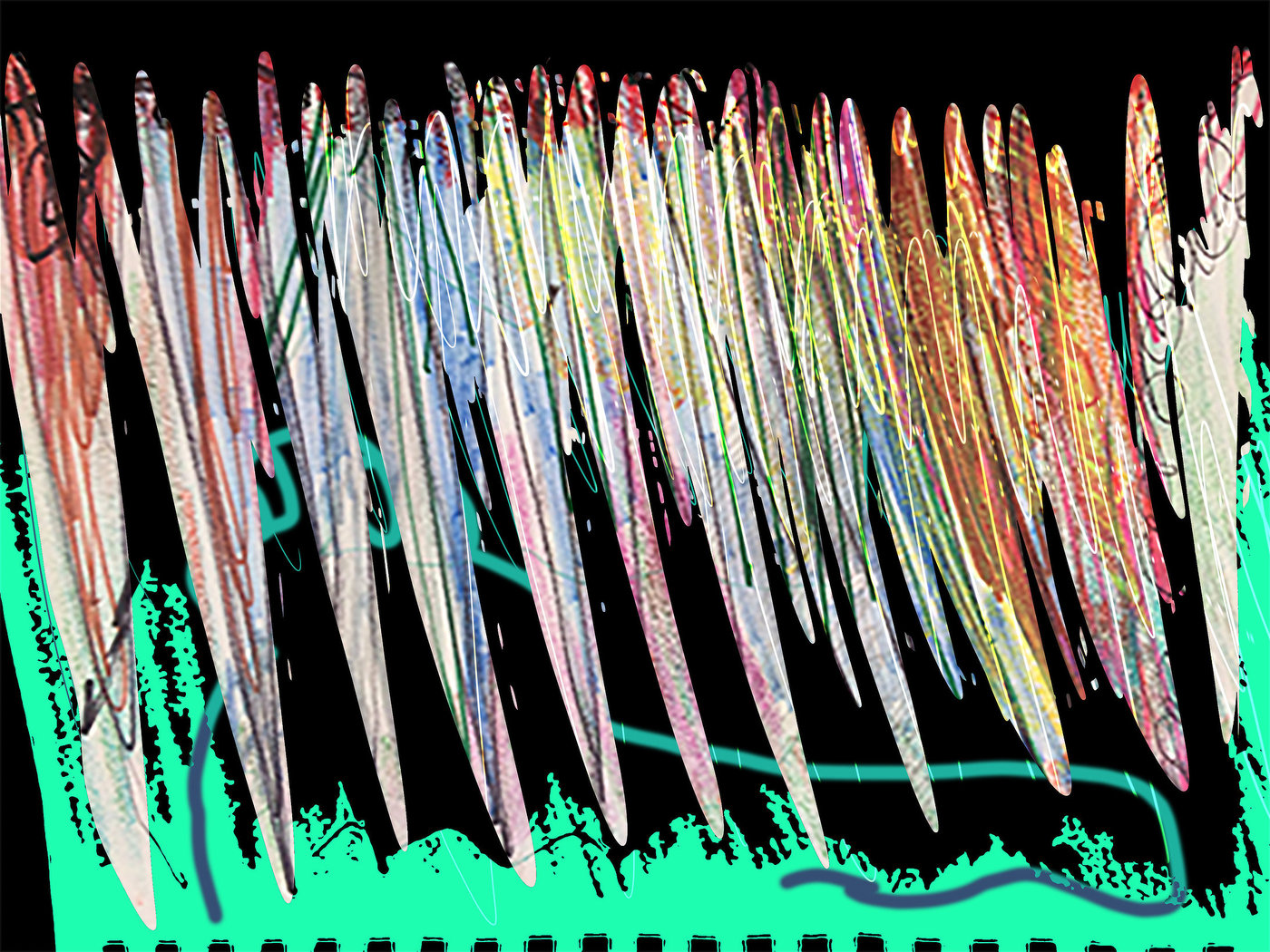
What Drawing Bench Is About. Have you ever watched someone tune a row of instruments all at once? That’s close to what I was after here. Drawing Bench started as an attempt to line up a set of narrow, blade-like strokes and let each one carry its own colour temperature, its own slight wobble, while the deep black behind them did all the heavy lifting of holding the composition still. The mint green at the bottom — loud, almost-neon, impossible to ignore — was the last major decision, and it changed everything above it. This is a digital painting about repetition that never quite repeats, and about the gap between a mark you planned and the one that actually landed.
Living With It
I left this piece open on my second monitor for about four days after I thought it was done. Not zoomed in, just sitting there at half-size behind my browser tabs. The thing is, the black reads differently when you aren’t staring directly at it — it becomes a room the strokes hang inside rather than a flat backdrop. And that mint strip along the bottom kept catching my eye every time I switched windows, like a shelf or a stage edge. Honestly, the piece felt more resolved at arm’s length than it did at 100%. That half-awake glancing told me more than any pixel-level check. I only signed off on it after I stopped noticing it, which sounds backwards, but that’s usually how it works.
Layering & Texture
The strokes look singular, but each one is a small pile-up of maybe three or four passes — a base shape in a dusty copper or rose, then a semi-transparent overlay with a different hue shifted cooler or warmer, then a thin white or cream line riding the top edge like a seam. I used a pressure-sensitive brush set to about 40% opacity for the overlays, which gave me that see-through, almost-watercolour look inside shapes that are otherwise hard-edged. The black isn’t flat either; if you look at the lower half, you can see where I smeared a textured eraser through it, leaving those crunchy, speckled green edges where the mint layer underneath bleeds through. Building up a digital painting this way — smear, erase, re-lay, adjust — is slower than people assume. Each blade-shape took two or three minutes of nudging before it felt like it belonged next to its neighbours.
What I’d Do Differently
I’d push the green further. That’s the honest answer. The mint strip is already the loudest thing in the piece, but looking at it now I wonder what would have happened if I’d let a few green tendrils climb higher into the black, threading between the strokes like vines. The curving teal line that snakes across the lower-middle section hints at that idea, but I was too cautious with it. I kept pulling it back, worried it would compete with the rhythm of the verticals. But maybe competition was exactly what the piece needed in that zone — a second kind of energy cutting against all those parallel arcs. Something almost reckless, half-planned.
Surface Choices — Honest Notes on Digital
Can’t skip this one even though there’s no physical surface. Working digitally means my “surface” is a set of brush behaviours and canvas textures baked into presets. For Drawing Bench, I loaded a canvas grain overlay at about 8% — just enough to give the white and cream lines a bit of tooth so they didn’t look clinical. And the eraser I used on the black had a spatter mask, which is why those lower edges look chewed-up rather than clean. The resistance isn’t real, but the decisions about where and how to fake it are the same decisions I’d make on paper. Different tool, same conversation.
Context — Where This Fits in the Digital Series
Drawing Bench sits in my Digital series, which is where I put work that starts and stays on screen — no scanning, no photo source, just direct mark-making with a stylus. This piece leans harder into repetition and horizontal rhythm than most of the others in the series, which tend to be looser, more cloud-like. I wanted something that felt almost like notation, a row of tallied marks, which is where the title came from — the image of sitting at a long bench making one mark after another after another. You can see the full piece on the product page. And if you’re curious about the rest of my practice, there’s more on my bio page.