Letting the Lines Run
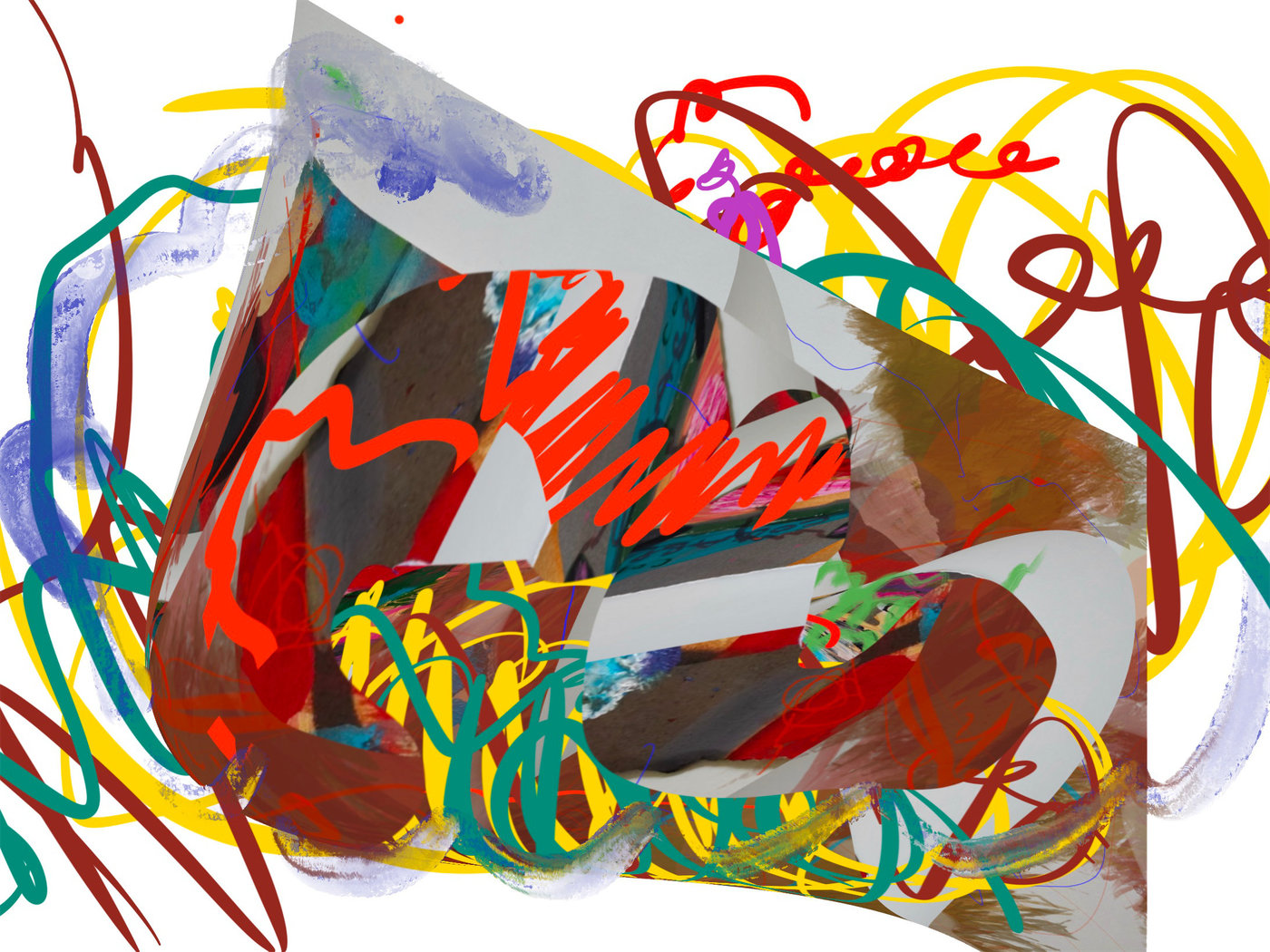
What even is this piece? A pile-up. That’s the honest answer — Deep Swirl started as a collision of leftover digital fragments I’d been dragging around my desktop for weeks, half-finished colour tests and cropped photos of older paintings that I couldn’t bring myself to delete. The idea was to layer them until something surfaced that felt right, something with enough weight in the middle and enough chaos around the borders to hold together as a single image rather than a scrapbook page. Not a plan, exactly. More like a controlled avalanche.
Scale & the Body — How Size Changed the Way I Worked
I work on a tablet at my dining room table. It’s kind of cramped, so the 2200-pixel-wide canvas felt bigger than it sounds — I had to zoom out constantly just to see the whole thing, then zoom back in to lay down marks that looked spontaneous at full resolution. That back-and-forth changed the way my arm moved. Zoomed in, I was making tight, almost-nervous scribbles with my wrist; zoomed out, I’d switch to full-arm sweeps, the stylus pressure cranked up so the teal loops and those thick yellow arcs would read as gestural from a distance. My shoulder was sore by the end of the first session. And there’s a funny thing about digital work at this scale — you can’t see the tooth of a surface because there isn’t one, so every mark has to carry its own texture through line weight and opacity alone.
Layering & Texture — Building Up and Scratching Back
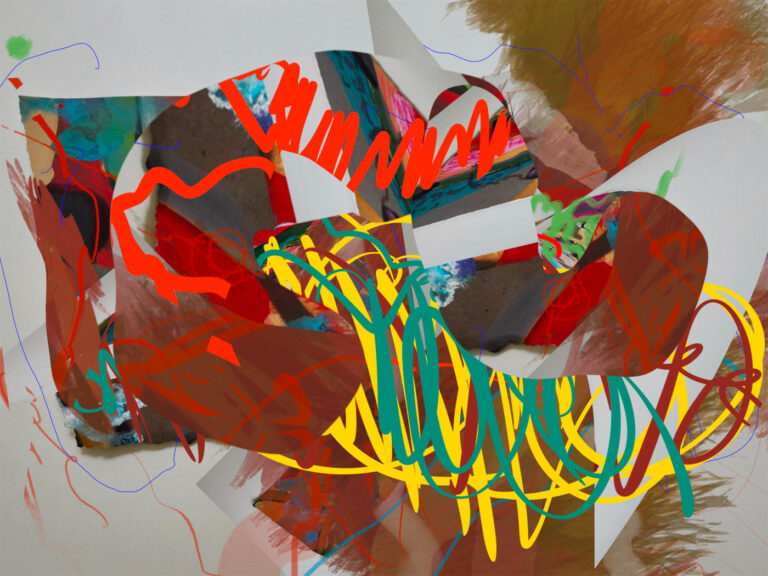
The centre started opaque. Brown planes, grey angular shapes that looked like folded paper — I built those first on separate layers, stacking them at slight rotations until the geometry felt off-kilter but not random. Half-transparent, almost-foggy. Then I went in with a hard round brush at full opacity for the vermilion scrawl, the kind of red that sits on top of everything and refuses to recede. I kept adding marks, it wasn’t working, then suddenly the stack of teal loops underneath started showing through the semi-transparent brown and the whole surface shifted from flat to deep.
Scratching back in digital means dropping layer opacity or erasing with a textured brush, and I did both. Some of those lavender washes at the upper left are actually remnants of a much heavier blue field I painted out. But I left just enough to cool that corner down.
Accidents & Saves — Marks That Weren’t Planned
That small purple squiggle near the top centre? Completely accidental — my stylus slipped while I was reaching for my coffee, and the pressure-sensitive brush laid down this tight little curly mark in a violet I hadn’t even selected intentionally. I almost hit undo. I stared at it for a solid minute. It looked so out of place next to the heavy maroon loops and the screaming red that I figured it had to stay precisely because it didn’t belong. And honestly, it ended up being the detail my eye returns to every time I open the file, this tiny almost-precious interruption in a piece that’s otherwise all muscle.
The green flashes in the lower-right quadrant were a save, too — I’d over-darkened that zone with brown, and it was swallowing the composition, so I hit it with a lime-green stroke at about 70% opacity just to crack it open.
When It Clicks — The Moment the Piece Started Working
It didn’t click until I flattened the view. For hours I’d been toggling layers on and off, second-guessing every overlap, and the piece looked busy in a not-good way — like a drawer full of tangled charger cables. The thing is, once I merged the visible layers into one and looked at the flat result on my monitor from across the room, squinting at it the way you’d squint at a painting on a gallery wall, the density suddenly read as depth. The yellow arcs pulled forward, the brown settled back, and that aggressive vermilion sat right in the middle distance. That was about 11 p.m. on a Tuesday. I saved, closed the file, and didn’t touch it for three days.
Context — How This Fits into the Digital Series
Deep Swirl belongs to my ongoing Digital series, where every piece starts from some combination of photographic fragments, painted textures, and raw digital marks — a contemporary abstract painting process that borrows from collage without being collage, exactly. Compared to earlier works in the series, this one leans harder into the gestural line; earlier pieces used more photographic texture and less drawn energy. It’s a shift I’ve been making gradually, letting the hand dominate the found image rather than the other way around. You can see the full piece on the product page, and there’s more about my practice on my about page. This abstract digital painting sits squarely in the noisier end of the series, and I kind of like it there.