Tearing and Drawing Until the Whole Thing Moved
Collage Swirl is a pile of scanned collage pieces and a blank digital canvas. That’s where this started.
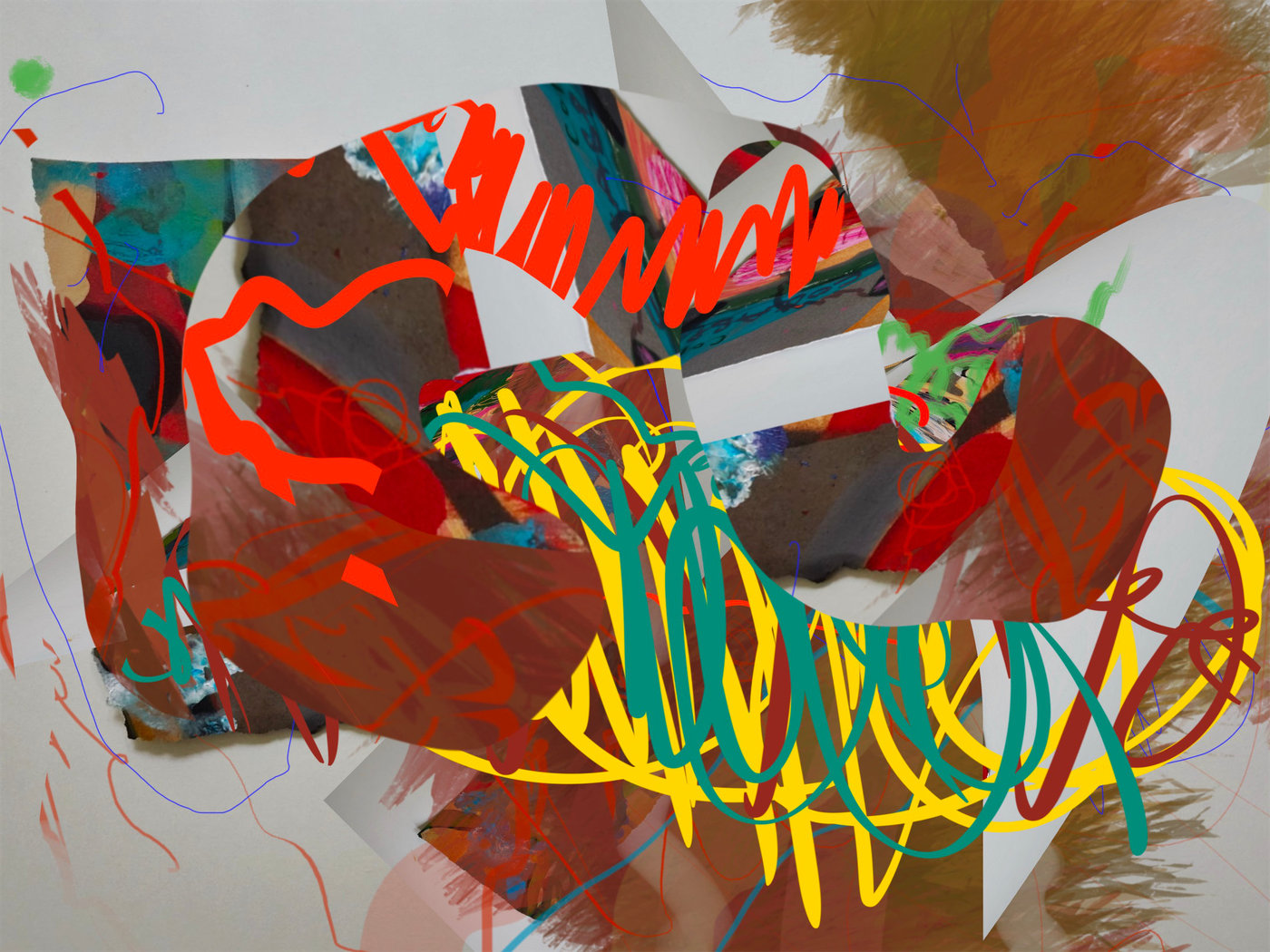
At its most basic, it’s an attempt to make a digital surface feel as hectic and material as a table covered in torn paper, paint, and open markers with their caps rolling somewhere on the floor. I wanted the piece to carry the weight of actual collage fragments while letting drawn lines spiral over and through them without caring about edges or borders. Not a polished composite. More like a drawer dumped out and then drawn into, hard and fast, until the whole mess had a direction it didn’t have before.
The First Mark
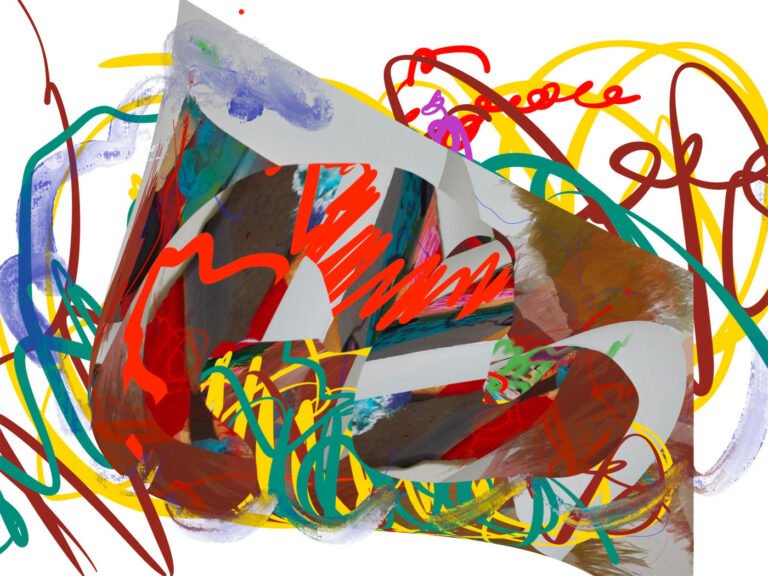
The first real move wasn’t a mark at all — it was dragging a set of scanned paper fragments onto the canvas and just rotating them, flipping, stacking. Those torn brown and dark-red shapes with their ragged edges, you can still see them underneath everything. Some had bits of older paintings on them — a flash of teal wash, a smear of something too-pink. And I left those accidents in because they felt more honest than anything I could paint fresh.
The actual first drawn mark was that looping red-orange line across the upper centre. Loud, fast, almost cartoonish. I used a pressure-sensitive brush set to mimic a fat chisel-tip marker, and I remember dragging it in one breath, no undo, no lifting. It sat there looking ridiculous for about ten minutes before I committed to matching its energy everywhere else.
Layering & Texture
Building this piece felt less like painting and more like stacking transparencies on an overhead projector — if anyone still remembers those.
The collage fragments went down first: brown, ochre, dark maroon shapes with visible torn edges. Then a second pass of semi-transparent red and burnt sienna broad strokes, almost dry-brush in character, using a textured bristle preset that drags and skips. Then the wild line work on top — teal loops, yellow scribbles, that wavy red-orange zigzag. Each layer was on its own group, and I kept toggling visibility, sometimes killing an entire layer just to see what lived underneath. Honestly, the piece looked better at about four layers than it did at seven, so I went back and deleted two middle passes that were muddying the darks. The thing is, digital layering gives you that luxury — subtraction without damage. But it also means you can second-guess yourself into a flat, over-blended nothing if you aren’t careful. I set a rule: no blending modes. Everything had to hold its own at normal opacity or get cut.
Those teal and yellow tangles in the lower half — they were drawn in one sprint, maybe ninety seconds total, stylus barely lifting, the scratching sound of the nib on the tablet surface filling the room.
Colour as Problem-Solving
The palette wasn’t planned. It was a series of problems solved sideways.
Those collage fragments came in with their own colours — muddy brown, deep maroon, a bit of teal bleed. Cold and heavy. The whole canvas felt like a dark well. So the red-orange went in as a rescue operation, basically, to break the weight apart. Immediate. Almost too loud. And then the yellow arrived because the red-orange needed a dance partner that wouldn’t compete on the same frequency — it had to be warmer but lighter, a nearly-neon cadmium yellow that sat forward of everything else.
The hardest colour choice was that single green dot in the upper left corner. Barely there. I almost deleted it six times. But it does something strange — it pulls your eye to a quiet zone and gives you a breath before the centre swallows you again. A half-accidental pressure point.
Speed & Rhythm
Some marks in this piece took less than a second. Others I sat with for twenty minutes deciding whether they deserved to stay.
The red-orange zigzag across the top: fast. The wandering violet line around the outer edges: slow, deliberate, almost meditative — I was tracing the boundary of the composition, feeling out where the energy stopped. That line is so thin it nearly disappears at screen distance, but up close it’s doing real structural work, holding the whole sprawl inside an invisible fence. And then the yellow loops at the bottom were fast again, reckless, my hand moving before my brain caught up. I could hear my own breathing speed up. That’s the tempo shift that makes the piece work, I think — the contrast between the controlled collage placement and the drawn-line chaos layered over it.
One run-on moment: I kept adding teal scribbles, it wasn’t working, the lower centre was turning into soup, then I dropped the opacity on the whole teal layer to about seventy percent and suddenly everything clicked.
Context
Collage Swirl sits inside my Digital series as one of the more aggressively layered pieces — a kind of stress test for how much collage material and gestural drawing can coexist before the surface collapses.
The series overall is about exploring what a contemporary abstract digital painting process can borrow from physical collage and mark-making traditions without pretending to be analog. I scan real paper. I draw with real pressure. But I also cut, paste, delete, and undo in ways that no physical surface allows. This piece leans hard into that contradiction — it looks handmade, even messy, but every layer is non-destructively editable. That gap between appearance and reality is where the interesting questions live for me right now.
You can see Collage Swirl on its product page or read more about my work on the About page.